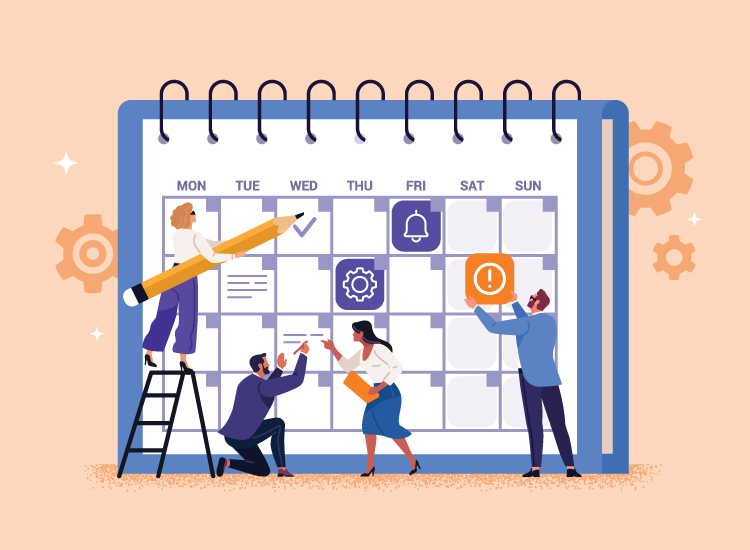



To turn a long-term goal from a dream into reality, you can make the work less daunting by breaking it down into bite-sized pieces that are relatively easy to finish. You can turn these chunks into short-term goals. While digital tools like workforce management software streamline the scheduling process for short-term goals, careful planning requires deciding what you want to achieve with each goal.
Determine your goal timeline
Defining SMART goals is a crucial step toward achieving the long-term goal. Try to list all the dependencies that must be satisfied to meet the long-term goal, then create short-term goals that fit the SMART framework (i.e., goals should be Specific, Measurable, Achievable, Realistic, and Time-bound). Using this framework helps guarantee that each short-term goal is clearly defined, planned, and trackable. Once you’ve established a meaningful long-term goal, you can forecast a timeline for completion and begin to define a series of short-term goals to be prioritized and scheduled.
What’s the ideal length for a short-term goal?
If the length of a short-term goal is the amount of time scheduled to finish it, then almost any length is possible. You can break goals into years, quarters, months, weeks, and days. No matter what length you choose, it should be smaller than the length of your long-term goal. So, you could break a yearly long-term goal into shorter monthly, weekly, or daily short-term goals, or you could break a monthly long-term goal into weekly or daily short-term goals, etc.
You may want to use different criteria for the length of personal and business short-term goals. You have more control over your personal time, while workforce management issues like staffing and scheduling often decide the length of a business goal.
Long-term goals vs. short-term goals
Long-term goals embody the organization’s mission. They represent future improvement or growth. According to a Harris Poll of 259 businesses in various industries, 86 percent believe that having a defined purpose is vital to growth. Putting a goal down on paper makes it much more likely that you’ll achieve it.
Short-term goals are like steps along the path leading to this vision. Having a long-term goal keeps you focused and motivated, but it may be difficult or impossible to achieve the larger objective without actionable short-term goals.
By breaking a long-term goal into smaller tasks and setting short-term milestones, you can overcome the fear that you can’t get it done. Short-term goals should be attainable and measurable. If your long-term goal is big, your short-term goals may be challenging. However, there’s no point in setting a short-term goal that’s so difficult that you or your team can’t achieve it. The key is finding the balance between too hard and too easy.
Make time to track progress
To achieve a long-term goal, you need to track the progress of each short-term goal, know when each is complete, with appropriate metrics. As you see the completion of each short-term goal, it takes you closer to your long-term goals, and provides constant motivation.
Depending on team size, you may be tracking several goals at once. Using a workforce management tool can help simplify this process. For example, you can set a due date for each short-term goal and set automated reminders to update progress.
You may find that priorities change as you progress towards a long-term goal. Be ready to modify your timeline or add or subtract short-term goals. A workforce management solution makes it easier to analyze and adjust your schedule and goals. Being flexible with your short-term goals will help you overcome challenges and take advantage of new opportunities that arise.